···
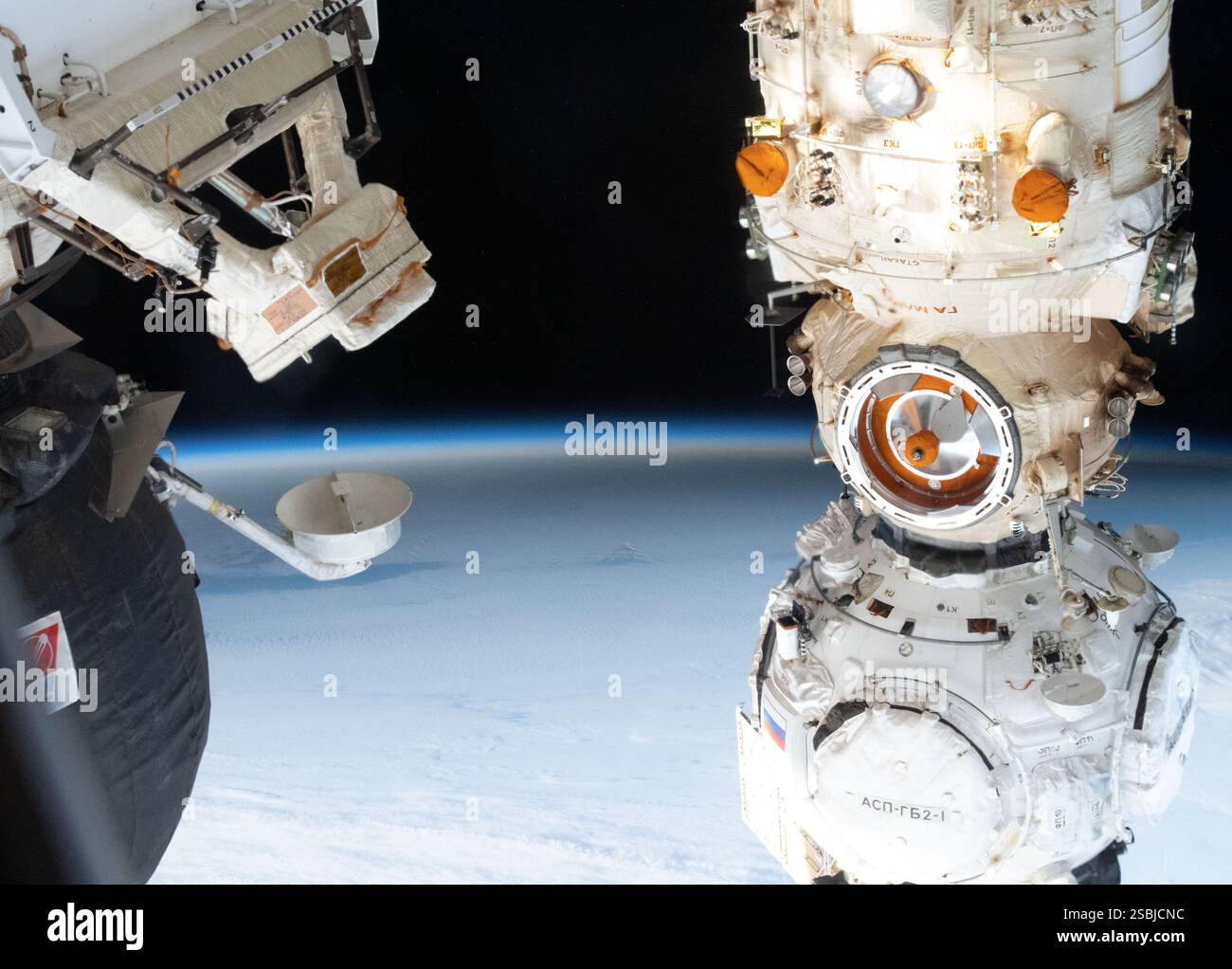
The shadow of the Moon, caused by a solar eclipse over Antarctica, is viewed from the International Space Station in orbit above the south Atlantic Ocean on December 4, 2021. The Russian Prichal module attached to the Nauka multipurpose docking module on the space station can be seen in the foreground. Image details File size:
53.4 MB (2.7 MB Compressed download)
Open your image file to the full size using image processing software.
Dimensions:
5100 x 3660 px | 43.2 x 31 cm | 17 x 12.2 inches | 300dpi
Date taken:
4 December 2021
Search stock photos by tags
Similar stock images RF 3E28JT2 – A total lunar eclipse photographed from Perth, Western Australia. The red colour of the moon is caused by Rayleigh scattering of light. RF 3DFN1M3 – A high-magnification view of a total lunar eclipse, showing the Moon fully within the Earth's umbral shadow and displaying the reddish color caused by RF 2FX86BP – A full moon super moon taken with a high iso at night time framed by foilage of trees, grain is caused by the high iso RM 2ADNJGP – Solar eclipse. Historical artwork depicting the chaos caused due to a solar eclipse in Peru. A solar eclipse occurs when the Moon obscures the Sun as RM 2HA10R3 – International Space Station, Earth Orbit. 04 December, 2021. The Moon's shadow, caused by a solar eclipse over Antarctica, seen from the International Space Station as it orbits 269 miles above the south Atlantic Ocean December 4, 2021 in Earth Orbit. In the foreground, is the Russian Prichal module attached to the Nauka multipurpose docking module. Credit: NASA/NASA/Ä¢¹½´«Ã½ Live News RM 2FWWJE4 – The diamond ring effect of a total solar eclipse; July 11; 1991; La Paz; Mexico; in false color. The diamond ring effect is caused by the last (or first) light of the Sun peeking out from the Moon's shadow during a total eclipse. RF 2HGF1YD – Abstract solar eclipse caused by a Lunar event with ring of fire. Animated abstract view of a total solar eclipse RM 2X00YMH – An attendee shows a projection of the partial solar eclipse outside of the Cradle of Aviation Museum's Solar Eclipse Viewing Party and Activities event in Garden City, Nassau County, Long Island, New York. A solar eclipse moved across North America, completely blocking the sun in its path over certain areas of Mexico, the United States and Canada. Most American locations, including Long Island and New York City, witnessed a partial eclipse. The eclipse was caused by the moon orbiting in between the sun and the Earth, temporarily blocking the sun. The next total solar eclipse over the U.S. will RM D451B0 – A total lunar eclipse on December 21, 2010, caused the Moon to pass through Earth’s shadow, appearing red. The event was observed across the United States, contributing to astronomical study, observation of celestial mechanics, understanding of Earth-Moon interactions, and public engagement in science and skywatching activities. RM W09CEC – The moon blocks the sun creating a Total Solar Eclipse over Smith Rock State Park in Terrebonne, Oregon on August 21, 2017. Smithrock.com provided access to thousands visiting the State where the moon's shadow caused skies to darken for nearly two minutes. The eastbound orbit of the moon creates a rare opportunity for millions of Americans to view the spectacle as it traverses the USA from Oregon to South Carolina. .Photo by Joe Marino/UPI RM 2X00RWG – An attendee shows a projection of the partial solar eclipse outside of the Cradle of Aviation Museum's Solar Eclipse Viewing Party and Activities event in Garden City, Nassau County, Long Island, New York. A solar eclipse moved across North America, completely blocking the sun in its path over certain areas of Mexico, the United States and Canada. Most American locations, including Long Island and New York City, witnessed a partial eclipse. The eclipse was caused by the moon orbiting in between the sun and the Earth, temporarily blocking the sun. The next total solar eclipse over the U.S. will RM PCHRYF – Blood moon is a term used to describe the Moon’s reddish appearance during a total lunar eclipse caused by sunlight refracted through Earth’s atmosphere. On July 27–28, 2018, a total lunar eclipse visible over Iraq produced this effect as the Moon set in the early morning sky. The archival image records the eclipse phase with the Moon low on the horizon. RM 2AG61YH – . Elements of theoretical and descriptive astronomy, for the use of colleges and academies. the Red Flames; as observed by OrFeilitzsch, at Castellon de la Plana. SOLAR ECLIPSE. 139 tfhere the same. As the moons motion towards the ea&t is morerapid than that of the earth (and consequently of the shadow),the eclipse will begin at the eastern limb of the moon. A totaleclipse of the moon may last for nearly two hours. Even whentotally eclipsed, however, the moon does not, in general, disappearfrom view, but shines with a dull reddish light. This phenomenonis caused by the earths atmosphere, which