
Roman herringbone brick paving amid the ruins of the Grotte di Catullo or Grottoes of Catullus, a large villa built between the end of the 1st century BC and 2nd century AD, at Sirmione, Lombardy, Italy. The ruins are on the headland tip of the Sirmio peninsula, a promontory at the southern end of Lake Garda. Bricks or stones laid in a herringbone pattern were known as ‘opus spicatum’ or ‘spiked work’.
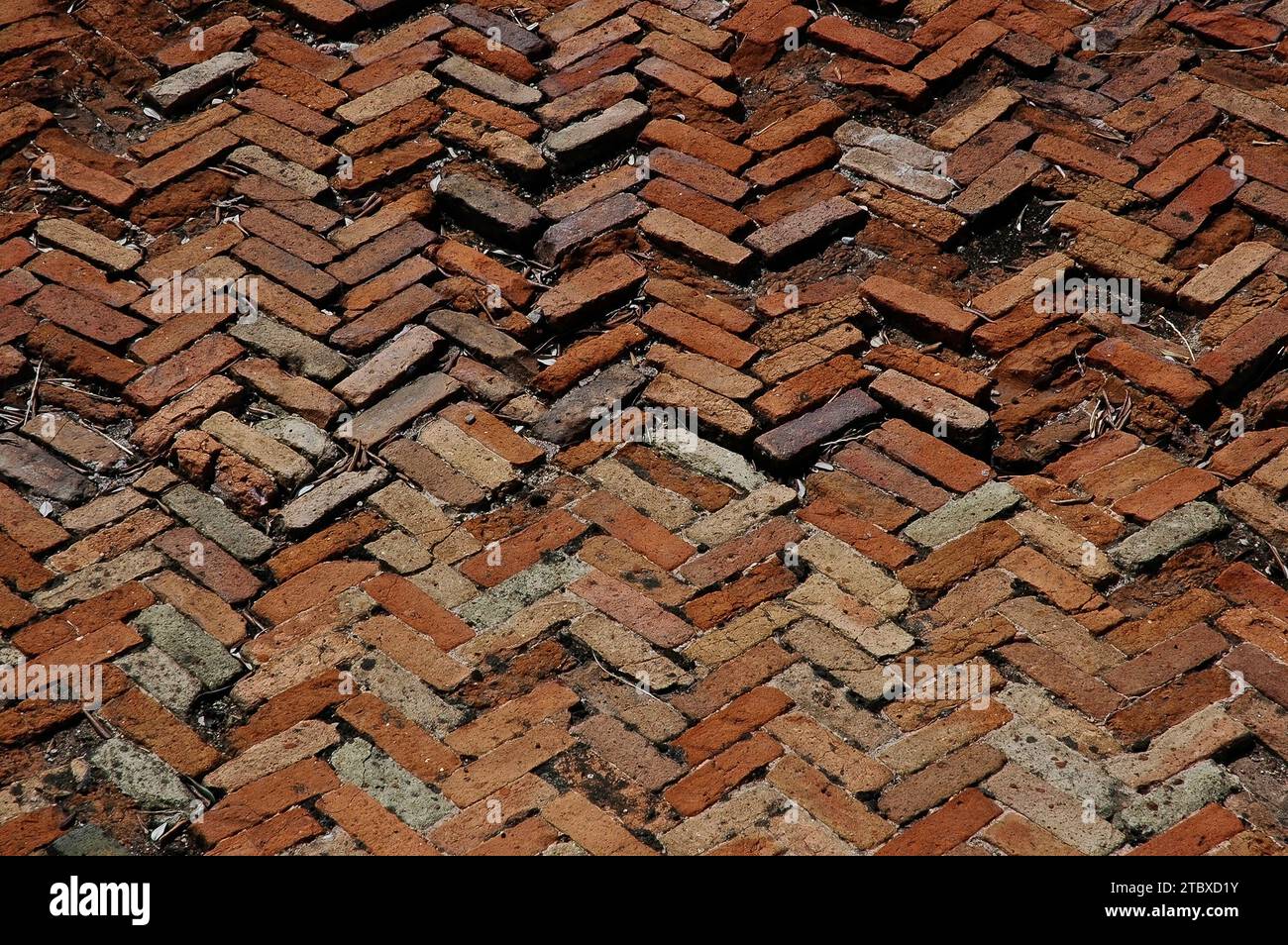
Image details
Contributor:
Terence KerrImage ID:
2TBXD1YFile size:
17.2 MB (1.8 MB Compressed download)Releases:
Model - no | Property - noDo I need a release?Dimensions:
3008 x 2000 px | 25.5 x 16.9 cm | 10 x 6.7 inches | 300dpiDate taken:
12 July 2006Location:
Grotte di Catullo or Grottoes of Catullus,Sirmione, Lake Garda, Lombardy, ItalyMore information:
This image could have imperfections as it’s either historical or reportage.
Sirmione, Lake Garda, Lombardy, Italy: the Grotte di Catullo, on the headland tip of the Sirmio peninsula, a 3.5km promontory into Lake Garda at its southern end. Bricks or stones laid in a herringbone pattern were known as ‘opus spicatum’ or ‘spiked work’. The Grotte di Catullo or Grottoes of Catullus are the ruins of a large Roman villa or country house, built between the end of the 1st century BC and 2nd century AD, lying amid olive groves. There are vast substructures built to sustain the main buildings, with a number of huge cisterns and thermal buildings in a long colonnaded terrace. Virtually nothing is left of the villa itself because it was used as a quarry for building stones. The poet Catullus (c. 84 BCE - 54 BCE) was born in Verona and he did spend time at his family’s villa at Sirmione. However, the Grotte di Catullo villa was probably built after Catullus died and, in any event, was far too opulent a property to have been affordable to him or his family. The Grotte di Catullo villa possibly belonged originally to Gens Valeria, an aristocratic family from Verona, and then, in the 100s BCE, perhaps to Gaius Herennius Caecilia, quaestor of the Gallia Narbonensis, member of the Roman Senate and patron of Verona. The degradation of the villa began in the 200s CE and, in the 400s CE, the complex became part of defence structures built at the northern end of the Sirmio peninsula. D0143.A1695

