
. Central Asiatic Expeditions of the American Museum of Natural History, under the leadership of Roy Chapman Andrews : preliminary contributions in geology, palaeontology, and zoology. Central Asiatic Expeditions (1921-1930); Scientific expeditions; Natural history; Scientific expeditions; Natural history. AMERICAN MUSEUM NOVITATES [No. 144 Specific Characters.âUngual phalanges very large, laterallj- compressed, strongly recurved, super-raptorial in type. This skull was found in the soft sandstone matrix lying along- side a skull of Protoceratops andrewsi. Although slender and diminutive, it i
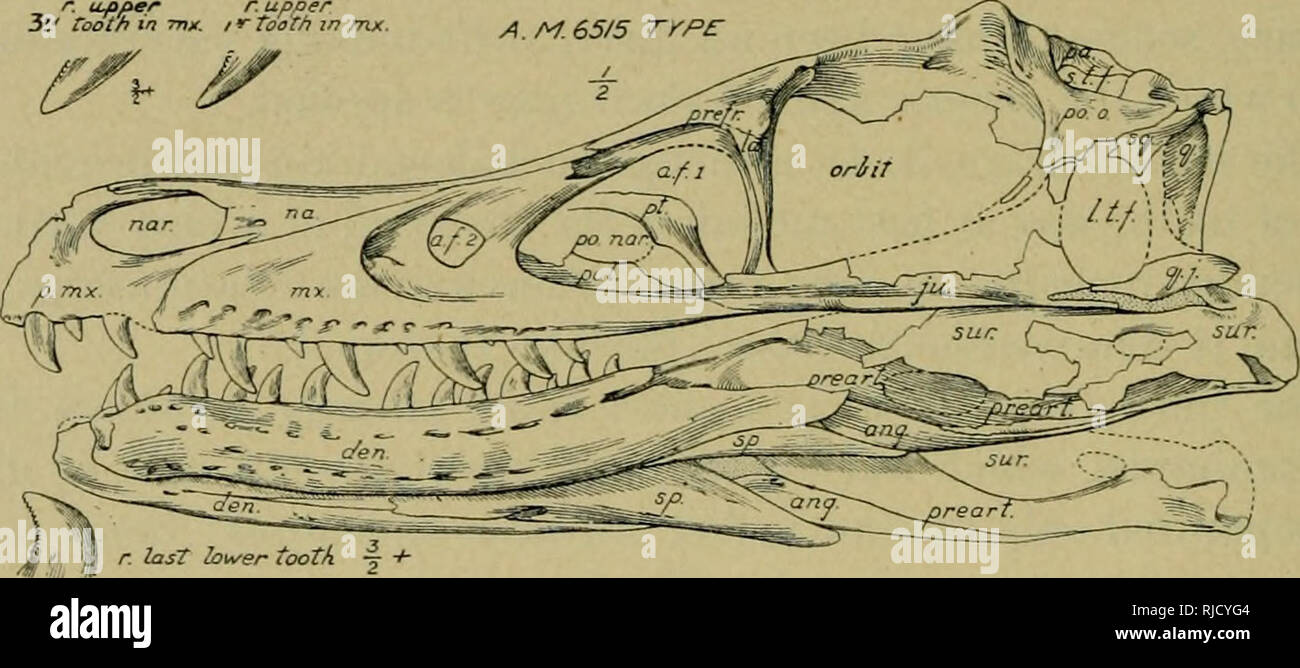
Image details
Contributor:
Library Book CollectionImage ID:
RJCYG4File size:
7.1 MB (321.2 KB Compressed download)Releases:
Model - no | Property - noDo I need a release?Dimensions:
2370 x 1054 px | 40.1 x 17.8 cm | 15.8 x 7 inches | 150dpiMore information:
Access rights only. This is a handout or public domain image supplied by a third party. Ä¢¹½´«Ã½ grants access to the digital file but provides no warranties regarding copyright or moral rights. Alteration, modification, or cropping is prohibited without prior approval. All commercial uses require advance authorization from the content provider.
This image could have imperfections as it’s either historical or reportage.
. Central Asiatic Expeditions of the American Museum of Natural History, under the leadership of Roy Chapman Andrews : preliminary contributions in geology, palaeontology, and zoology. Central Asiatic Expeditions (1921-1930); Scientific expeditions; Natural history; Scientific expeditions; Natural history. AMERICAN MUSEUM NOVITATES [No. 144 Specific Characters.âUngual phalanges very large, laterallj- compressed, strongly recurved, super-raptorial in type. This skull was found in the soft sandstone matrix lying along- side a skull of Protoceratops andrewsi. Although slender and diminutive, it is none the less of typical megalosaurian or theropod type, suggesting a family relationship to the Megalosauridse. The ten or twelve sharply I'ecurved teeth are strongly serrate on the posterior border, less serrate on the anterior; thirteen to fourteen in number in each jaw, somewhat homodont or similar in form, although differing in size, recur- vature and serration; irregular or alternating in replacement, so that the wide gaps between the recurved crowns are perfectly adapted to the sudden seizure of light and swift-moving prey; sharply compressed, strongly recurved phalanges facilitating the holding of the prey; the long rostrum and wide gape of the jaws indicate that the prey was not only living but of considerable size.. r. iasT lower tooTk Fig. 1. Type skull and jaws of Velociraptor mongolieiisis (Amer. Mus. 6515). From the Djadochta formation. Protoceratops zone, central Mongolia. One-half natural size. Enlarged maxillary and mandibular teeth: (Above) first tooth in maxilla, double serration; third tooth in maxilla, single serration. (Below) posterior tooth in dentary, single serration. â §â + natural size. Measurements Skull, length over all, occiput to premaxillaries 176 mm., est. Facial length, anterior border of orbits to premaxillaries Ill Cranial length, anterior border of orbits to occiput 65 Faciocranial index 170% Mandibular length, tip of dentaries to b

